
Understanding Gross Up Provisions: Mutual Benefits for Landlords and Tenants

History
You may have heard of the Era of Excess, also known as the 1980s, during this time the office markets fluctuated dramatically because of the quick production and overbuilding. This was when many landlords, brokers, and tenants needed to understand the correlation between occupancy and operating expenses for the first time. By the 1990s the office markets began to recover and balance supply and demand. This leveling lasted up until the Great Recession. Occupancies dropped by 10 to 15 percent in 2008 through 2010. This drop brought back the strong focus of operating expense gross ups. As of 2014, the office market is recovering with the steady growth of new construction as well as decent job growth. Until overbuilding occurs again, the market balance is predicted to increase tenants’ rents. The tenants will then keep pressure on lessening their overall expenses for leasing office space.
The term ‘grossing up’ was commonly used in the Southwest as there were unusually high vacancies in that area from the 80s to the 90s. However, in other regions the terms ‘adjusting expenses’ and ‘extrapolating costs’ were used. The term ‘extrapolating costs’ does the best in self-describing the process. According to the American Heritage Dictionary extrapolating costs is defined as “inferring unknown information from known information.” Though this term conveys a more exact description, ‘gross up’ has been widely adopted and used by most individuals.
Types of Leases
There are two general categories that office leases fall under: Gross Leases and Net leases. The difference between the two really comes down to who pays what. For a gross lease, the operating expenses are paid by the owner while net leases define how much of the operating expenses are paid by the tenant.
Gross Lease
When you own a property, you oversee the operations of the property. With that said, in a gross lease it says that the property owner pays either all or part of the operating expenses. There is a gross lease where the owner pays all expenses and is called pure lease, but it is not commonly used for commercial office buildings. With a pure gross lease, the tenant must only pay base rent and is not re-billed for the building’s standard utilities. In this scenario the tenant’s rent covers all the operating expenses, pays debt services, and provides a profit to the property owner. This is often desired by tenants who need to know what their lease cost is with certainty.
Net Lease
When you shift your focus to expenses that are endured by the tenant you are dealing with net leases. These can be seen in a multi-tenant setting as the supply and demand of the office sectors shift towards the owner. There are three types of net leases: Net, Net-Net, and Triple Net. To simplify and explain each one; you can think of it as a hierarchy. As another net is added to the name, the tenant agrees to pay another aspect of the cost. For example, a net lease is utilities, real estate taxes, and other special assessments, while a net-net lease requires all the payments of a net lease plus ordinary repairs and maintenance. And lastly the triple net lease encompasses everything within the net and net-net leases with the addition of capital improvements.
Types of Expenses
Operating Expense: Fixed vs Variable
Operating expenses are what keep buildings open and running. There are two types of operating expenses: fixed and variable. A fixed expense cost helps maintain that the building stays operational while variable expenses are costing that stems from the occupying tenant. There is another expense that incorporates both fixed and variable costs called semi-variable expenses.
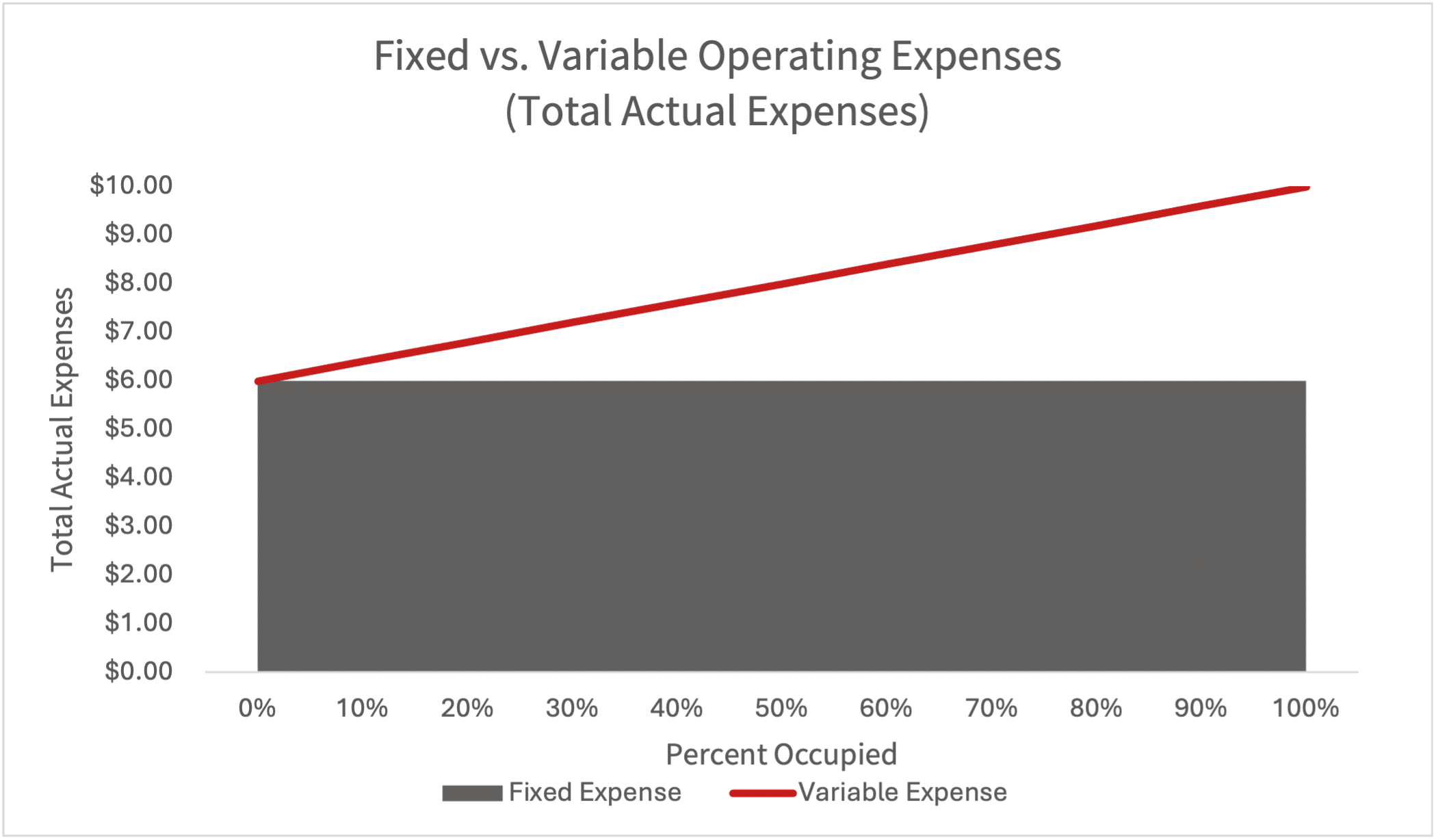

*As occupancy of the building rises from 0 percent to 100 percent, variable expenses are gradually accrued until reaching $10.00 per square foot in actual expenses for a fully occupied building. At $6.00 per square foot, fixed expenses account for 60 percent of the full total building expenses. The remaining 40 percent of total expenses are attributed to variable (and semi-variable) expenses as the building reaches full occupancy.
CAM
Common area maintenance, known as CAM, is a part of operating expenses. These expenses are areas that the tenant may use every day like elevators, parking lots, public bathrooms, lobbies, etc., that the landlord considers in the tenants’ expenses to maintain the area.
CAM is calculated by the tenant’s square footage divided by gross leasable area of the building which is then multiplied by the property’s total estimated annual CAM.
RET is an abbreviation for Real Estate Taxes. Real estate taxes are taxes placed by the local government. These payments are decided by the value of the property and a percentage is applied to calculate how much tax is owed.
Property Insurance and General Insurance
Property insurance: A type of insurance that helps protect property owners against financial losses from damage to the property.
General Insurance: Also referred to as general liability insurance, and helps businesses provide coverage for injury or property damage. This type of insurance protects against liability claims that occur on the property.
Capital Expenses
Capital expenses are also known as Capex. Capex’s are funds that the property owners use to keep and/or upgrade their physical assets. As these expenses are used to enhance the property, the owners usually capitalize them.
Reason for Grossing Up
So why gross up? As a landlord or tenant if expenses are not adjusted either party could be treated unfairly. It is beneficial because it contributes to establishing a fair economic setting for both tenants and property owners. It considers the variations in expenses and timing inherent in the initial leasing phase of new buildings, while also rectifying the proportional imbalances of partially occupied structures.
To prove this, there are financial proofs (see below) and conceptual proofs. The conceptual proof is that if (a) the tenant receives the services stipulated in the lease, and (b) these services are essentially ‘supplied to’ the premises leases by the tenant, then the tenant should remunerate for the received service based on the cost required per square foot.

If you have any questions, reach out to Chia Lin at chl@naihallmark.com
Contact Us for Your Personalized CRE Solutions.
-
Topics:
- Resources
